
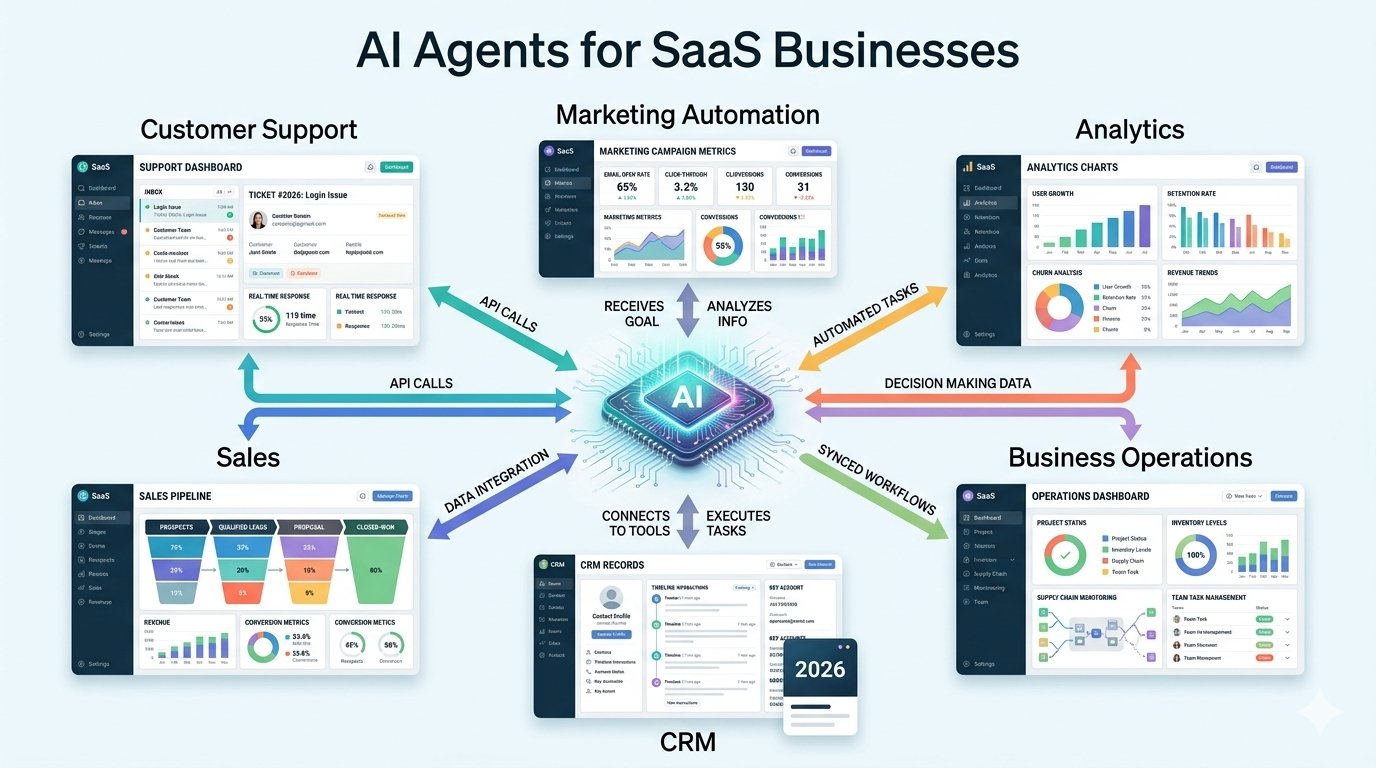
A year or two ago, software teams were asking whether their product needed a chatbot. In 2026 the question is different: can it actually get something done? That is what sits behind AI agents for SaaS businesses. An agent takes a goal, works out the steps, uses connected tools, and acts, instead of only answering a prompt.
Google Cloud's 2026 AI Agent Trends report treats agentic workflows as a major business theme, with companies chaining several agents together for complex processes. Deloitte's technology predictions describe SaaS becoming more adaptive and autonomous, and warn that agentic AI could change how companies buy and pay for software. So this is more than a feature trend. It may change how software delivers value at all.
Why AI agents for SaaS businesses matter in 2026
Classic machine learning came first, then generative AI let people talk to software in plain language. Now the attention is on agentic AI, where a system moves from producing an answer to finishing a task.
Interest is high, but adoption is uneven. Gartner's 2026 research found that only 17% of organizations had deployed AI agents when surveyed, while more than 60% expected to within two years. Gartner also says most deployments today are narrow in scope, nowhere near fully autonomous.
So the realistic opportunity is not handing your company to an AI. It is finding specific workflows where an agent can safely handle several steps while your team stays in the loop.
Assistants and agents are not the same thing
An assistant helps with one task at a time: you ask, it replies. An agent works toward a wider objective.
Take churn. A traditional AI tool might analyze a customer report when someone asks for one. An agentic workflow could watch approved customer signals, notice unusual changes, gather context, summarize what is happening, update a workflow, and alert the customer-success team, all without anyone starting the process. The difference is execution, and it is why AI agents for SaaS businesses are far more than a smarter chatbot.
Ten ways to use AI agents for SaaS businesses
Customer support
The easiest place to start. A support agent reads the question, checks an approved knowledge base, looks at the account, and replies. Advanced setups can open tickets, update records, or hand tricky cases to a person. The aim is not fewer support staff; it is letting them spend their time on the hard problems.
Sales
Reps lose hours to prospect research and CRM upkeep. An agent can prepare account summaries, help qualify leads, draft outreach for review, and keep records current.
Marketing
An agent can watch approved data sources, spot content opportunities, analyze campaigns, and compile reports with suggested next steps. A human still decides what goes live.
Onboarding
Onboarding strongly affects retention. An agent can learn what a new customer wants to achieve, guide setup, flag unfinished steps, suggest features, and call in a customer-success rep when someone is stuck.
Product usage monitoring
Agents can track falling usage, sudden spikes, ignored features, failed workflows, and odd behavior, then summarize it for the right team to investigate.
Internal operations
Document processing, reports, meeting summaries, task coordination, and internal requests all eat time. Small SaaS teams, where one person covers several roles, benefit most.
Data analysis
Analytics, billing, CRM, support, and marketing data live in separate tools. An agent can help people query and interpret all of it. The catch: messy or disconnected data limits what any agent can do.
Customer retention
If a customer stops using a feature they used to rely on, an agent can alert your customer-success team. The system raises the flag; a human chooses the response.
Security operations
Security teams drown in alerts and repetitive investigation. Google Cloud's report names security operations as an area where agents can take over time-consuming work so analysts can focus on priorities.
Multi-agent workflows
Possibly the most interesting direction. One agent researches a customer, another analyzes the data, a third drafts an action plan, and a person approves the final step. Google Cloud expects this kind of collaboration to grow in 2026.
The pricing question nobody can ignore
The biggest implication of AI agents for SaaS businesses may be economic rather than technical. SaaS has long been sold per seat. But if one agent can do work that used to need several people logged in, the link between users and value loosens. Deloitte expects companies to experiment with usage-based and outcome-based pricing as a result.
Gartner goes further, estimating that up to $234 billion of enterprise application software spending could be exposed to what it calls "agentic arbitrage" between now and 2030.
For founders that raises an uncomfortable but useful question: are you selling access to software, or a measurable result?
AI agents for SaaS businesses are not autonomous employees
There is a lot of hype, so stay grounded. Forrester's 2026 predictions expect enterprise software to start accommodating a digital workforce of AI agents. Even so, many teams are still at the early stage, and reaching production at scale is hard.
For most teams the practical win is focused automation. Rather than asking how to make the whole company autonomous, ask which repetitive workflow an agent could handle reliably, safely, and measurably. That question is far easier to answer and to test.
Data and governance are the real moat
AI agents for SaaS businesses are only as good as their context. If an agent cannot reach reliable information, it cannot make reliable decisions, so data quality, permissions, integrations, monitoring, and security matter more than before. Deloitte advises SaaS customers to invest in data management, access, integration, observability, and governance as these systems grow more complex.
That suggests the advantage will not come from plugging into the newest model. It is more likely to come from:
- Proprietary data and richer customer context
- Strong integrations and well-designed workflows
- Solid security
- Good evaluation systems
- Clear human-approval steps
Building AI agents for SaaS businesses is only half the job
Even a great agent will not grow if nobody finds it, and a website alone will not be enough as AI products multiply. Buyers turn up through search engines, AI answer engines, AI and SaaS directories, product discovery platforms, review sites, industry publications, communities, social media, and founder-led content.
Directories deserve a mention. Listing your product on relevant AI and SaaS directories creates extra references to it around the web. Keep expectations realistic, though: a submission guarantees no approval, rankings, traffic, or backlinks, because each directory sets its own standards. What works is an accurate, useful listing that states what the product does, who it is for, key features, main use cases, pricing, your URL, and the right categories.
Researching directories and preparing submissions by hand takes time. AI Listingo offers manual AI tool and SaaS directory submission services for founders who would rather not do it all themselves. It focuses on relevant submissions instead of promising instant rankings, and it works best alongside SEO, useful content, reviews, social distribution, community participation, and AI search optimization.
A simple plan for adopting AI agents for SaaS businesses
- Pick one valuable workflow. Do not try to automate everything at once.
- Measure the result. Track time saved, response time, conversions, satisfaction, or another metric that matters.
- Give the agent the right context. Connect only the data and tools it truly needs.
- Add human approval where it counts. Financial, customer-facing, security, and other high-risk actions need a person.
- Monitor everything. Logs, evaluations, error handling, and audit trails matter more as agents take on more.
- Build distribution alongside the product. Customers have to be able to find you.
Where AI agents for SaaS businesses are heading
Software is shifting from providing interfaces to helping people reach outcomes. In time, some interfaces may matter less as users simply say what they want. It will not happen overnight, though. Deloitte expects 2026 to bring plenty of experimentation and gradual restructuring, not an instant replacement of traditional SaaS.
That leaves founders a real window. Companies that pair useful agents with reliable data, strong workflows, human oversight, and effective distribution should be best placed as the market shifts.
Final thoughts
AI agents for SaaS businesses are one of the defining themes of 2026, and they go well beyond bolting a chatbot onto an existing product. Still, the technology is young. Adoption is uneven, and teams are wrestling with data quality, security, governance, reliability, and ROI.
The sensible path: solve one real problem, give the agent dependable context, measure how it performs, and keep people involved where it matters. And as more AI products crowd the market, being discoverable will matter almost as much as being innovative.
Frequently asked questions
What are AI agents for SaaS businesses?
Software systems that understand goals, reason through multiple steps, use connected tools, and carry out tasks with varying levels of autonomy.
Why are AI agents for SaaS businesses trending in 2026?
AI is moving from generating information to executing workflows, and major research and technology organizations are calling out agentic workflows as a key trend.
Are AI agents replacing traditional SaaS?
Not right now. The evidence points to experimentation, augmentation, and gradual change. Agentic AI may shift how software is built, used, and priced.
Can startups use AI agents for SaaS businesses?
Yes. Begin with focused workflows like support, lead qualification, research, onboarding, or reporting.
What is the difference between generative AI and agentic AI?
Generative AI creates or transforms content from a prompt. Agentic AI adds goal-oriented planning and execution, often across tools, data, and several steps.
Are AI agents fully autonomous?
Not necessarily. Autonomy depends on the system and use case, and many enterprise deployments still rely on human oversight and narrow workflows.
Why does data matter so much for AI agents?
Agents need accurate context to decide well. Poor-quality, disconnected, or inaccessible data seriously weakens agentic workflows.
Can AI agents reduce SaaS costs?
Potentially, by cutting time spent on repetitive work. Actual savings depend on implementation cost, workflow design, usage, and system quality.
How can an AI SaaS product improve its visibility?
Combine SEO, AI search optimization, content marketing, reviews, communities, third-party mentions, and relevant AI and SaaS directories.
Can directory submissions guarantee traffic or backlinks?
No. Approval, link attributes, rankings, and traffic vary by platform, so treat submissions as one part of a wider marketing strategy.
Build smarter. Get discovered. If you have an AI tool, AI agent, or SaaS product, explore AI Listingo and its AI & SaaS directory submission services to see how manual directory submissions can fit into your visibility plan.