
For years, SaaS founders asked one question: how do we rank higher on Google?
That question still matters. But it's no longer the only one.
More and more people now ask an AI assistant to do their software research for them. Instead of opening ten tabs and comparing ten websites, they type something like:
“What are the best AI project management tools for a small startup?”
And they get a short list of names in seconds. If your product isn't on that list, you may never even know you lost the customer.
That's why AI search optimization for SaaS has become worth your attention.
What Is AI Search Optimization for SaaS?
In plain terms, AI search optimization for SaaS means making your software easy for AI-powered search tools to find, understand, and (when it's a good fit) mention.
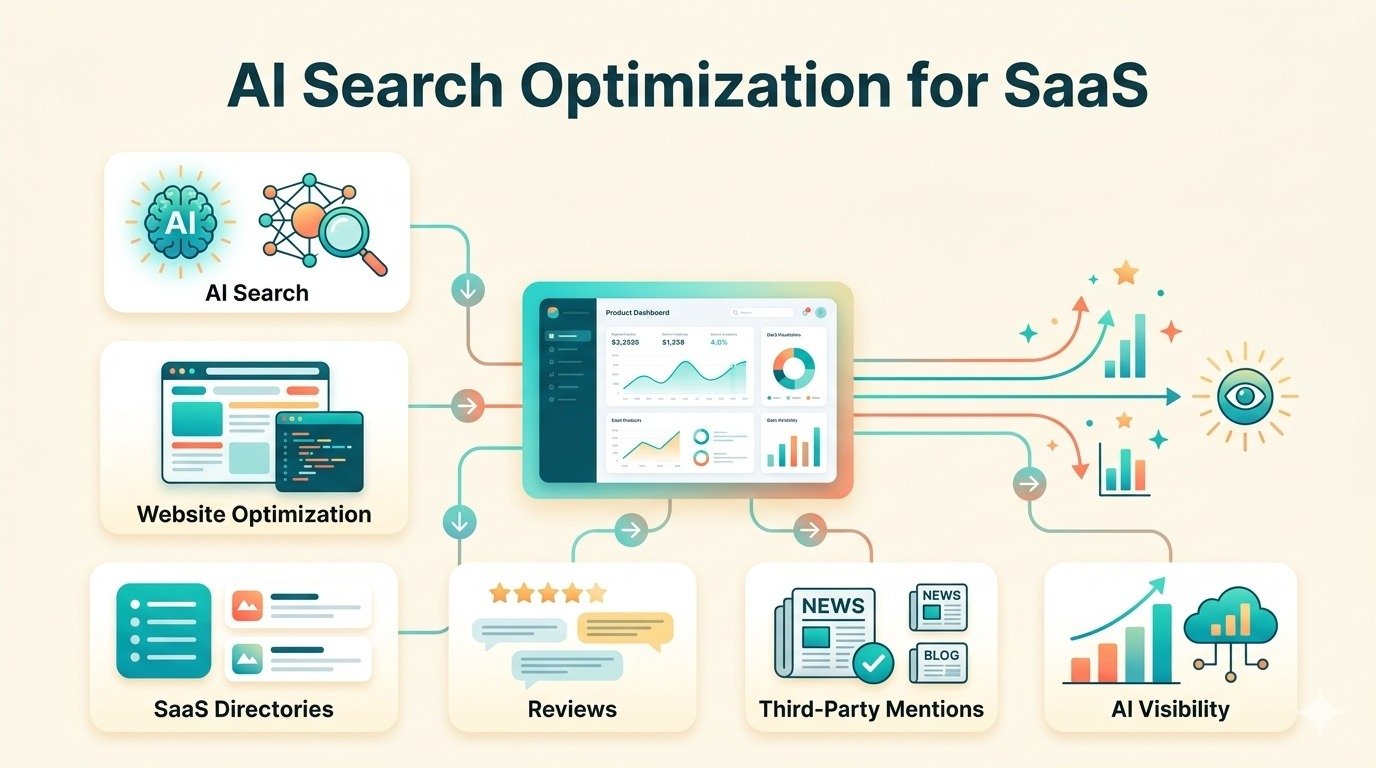
Traditional SEO is mostly about getting your web pages to rank. AI search optimization zooms out. It asks a bigger question: what does the internet as a whole say about your product?
That includes your own site, but also:
- Search engines
- AI-powered search platforms
- SaaS and AI tool directories
- Review websites
- Product discovery platforms
- Industry publications
- Social platforms and communities
- Business listings and other third-party sites
One honest note before we go further: nobody can guarantee that an AI tool will mention your product. Anyone who promises that is selling you something. What you can do is build a clear, consistent, credible presence that gives these systems more good information to work with.
Why This Matters for SaaS Companies
Picture someone shopping for an email marketing tool. A few years ago they'd have searched “best email marketing software.” Today they might ask:
Which email marketing tools work for a small SaaS company on a tight budget?
The AI will pull together an answer from what it knows and can find. If the only place your product is described is your own website, there's very little independent information to draw on. But if your product shows up in directories, reviews, comparison articles, and industry write-ups, there's a much richer picture of who you are and what you do.
That's the whole idea. The more clearly and widely your product is described, the easier it is to understand.
It's More Than Traditional SEO
SEO and AI search optimization overlap a lot. The fundamentals still count: keywords, search intent, technical health, backlinks, page experience, quality content, and internal links.
The difference is the scope. Imagine a SaaS product with a clean website, clear product pages, solid documentation, profiles on relevant directories, real customer reviews, mentions on industry sites, and the same company details everywhere. That product is simply easier for both people and machines to understand than one that lives only on its own domain.

Here's how to build that kind of presence.
1. Make Your Website Easy to Understand
Before you worry about AI at all, check that your own site explains what you do. A visitor should know within seconds:
- What your product is
- Who it's for
- What problem it solves
- What makes it different
- What its key features are
Skip the buzzwords. Compare these two:
An intelligent next-generation platform designed to revolutionize modern workflows.
Project management software for small SaaS teams to manage tasks, deadlines, and client projects.
The second one tells you something. It helps your visitors, and it gives search systems clear information to work with.

2. Build Pages Around Your Main Use Cases
A common mistake is cramming everything onto the homepage. Give each major use case its own page instead.
A CRM company, for example, might have pages for CRM for startups, CRM for agencies, sales pipeline management, and lead management. Each page lets you go deeper on a specific problem and match a specific search intent.
The catch: make every page genuinely useful. Dozens of thin pages written just to catch keywords will do more harm than good.
3. Get Listed on the Right Directories
This one matters a lot for early-stage products. Directories help people discover software, and they also add to your wider online footprint.
Depending on your category, consider places like:
- Product Hunt
- G2
- Capterra
- SaaSHub
- AlternativeTo
- AI tool directories
- Startup directories
- Industry-specific software directories
You don't need all of them. Relevance beats volume. A handful of well-chosen listings is worth more than hundreds of random ones.
Each profile should include a clear description, your website URL, the right categories, key features, and use cases, all accurate and up to date.
If you'd rather not spend your own time on submissions, AI Listingo offers manual AI and SaaS directory submission services.

4. Keep Your Product Information Consistent
Imagine your website calls your product an AI writing assistant. One directory calls it a productivity tool. Another says it's a content management platform. A third still has a description from two years ago.
That's confusing for people, and it's confusing for AI systems too.
Keep these details consistent everywhere:
- Brand and product name
- Category
- Main features
- Target audience
- Primary use cases
- Website URL
- Company description
You don't have to paste the same paragraph on every platform. Rewriting it to suit each one is actually a good idea. Just make sure the core facts always match.
5. Earn Real Reviews and Mentions
Independent opinions carry weight because they come from outside your own marketing. Ask happy customers to leave honest reviews on the platforms that matter in your space.
Also look for ways to get mentioned in:
- SaaS publications and industry blogs
- Product comparison articles
- Startup communities
- Podcasts and interviews
- News coverage
- Expert roundups
The key word is genuine. Don't fake reviews or make misleading claims to game the results. It's unethical, it tends to backfire, and long-term visibility comes from credibility.
6. Write Content That Answers Real Questions
People talk to AI assistants in full sentences. They don't type “CRM software.” They ask things like:
What's the best CRM for a five-person SaaS startup?
or
How can an agency manage client projects without complicated enterprise software?
So write content that answers questions like these: how-to guides, comparisons, tutorials, FAQs, use-case articles, and beginner guides.
A good test before you write anything: what is the customer actually trying to figure out? That usually leads to better content than chasing search volume alone. Google's own guidance on creating helpful, people-first content is a good checklist to keep nearby.
7. Build a Footprint Beyond Your Own Site
AI search optimization for SaaS isn't just about publishing more blog posts. Your brand should show up in several places:
- Owned: your website, blog, documentation, and knowledge base
- Third-party: SaaS directories, review platforms, startup directories, and industry publications
- Community: product communities, professional networks, and relevant discussion forums
- Content: tutorials, interviews, case studies, and expert contributions
Together, these give the web a fuller picture of who you are.

8. Don't Skip Technical SEO
None of this replaces the basics. Search engines still need to crawl and understand your site. Make sure it:
- Loads quickly and works well on mobile
- Has crawlable pages and a clear structure
- Uses descriptive page titles and meta descriptions
- Has sensible internal links
- Avoids unnecessary duplicate content
Good technical SEO is the foundation everything else sits on. Free tools help here: PageSpeed Insights checks your loading speed, and Google Search Console shows how Google crawls and indexes your pages. If you're new to all this, Google's SEO Starter Guide covers the basics clearly.
9. Use Structured Data Where It Fits
Structured data helps search engines make sense of your pages. For SaaS sites, the relevant schema types often include Organization, SoftwareApplication, Product, Article, and FAQ. Google's introduction to structured data explains how it works, and the Rich Results Test lets you check your markup.
One rule: the markup must match what's actually visible on the page. Don't use it to claim things you can't back up.
10. Track Mentions, Not Just Rankings
Rankings, organic traffic, click-through rate, and backlinks are all still useful. But add a few more things to your dashboard:
- Brand mentions
- Directory profiles
- Review growth
- Referral traffic
- Branded searches
- Third-party publications and comparisons
You can also test relevant questions in AI tools every so often to see whether your product comes up. Just don't read too much into any single test. Answers vary by platform, wording, location, and freshness, so one result proves very little either way.

A Simple Checklist to Start With
If you're starting from zero, don't try to do it all at once. Work through this:
Website
- Clear homepage messaging
- Strong product descriptions
- Dedicated use-case pages
- Helpful blog content
- Easy-to-find pricing and product info
SEO
- Keyword research and search-intent-focused content
- Technical SEO and internal linking
- Relevant structured data
Off-page visibility
- Relevant SaaS, AI, and startup directories
- Review websites
- Industry publications
Brand authority
- Genuine customer reviews
- Expert contributions, case studies, and interviews
- Useful educational content
Measurement
- Organic and referral traffic
- Brand mentions and branded searches
- Directory visibility and reviews
- Occasional AI search tests
Mistakes to Avoid
It's tempting to treat this like another SEO shortcut. Don't. Watch out for these:
- Submitting to every directory you can find. A hundred irrelevant listings aren't better than a few relevant ones.
- Faking reviews. Real feedback is worth far more over time.
- Publishing piles of low-quality AI-generated articles. AI can help with research and drafting, but content still needs accuracy, real experience, editing, and a reason to exist. Google addresses this directly in its guidance on generative AI content.
- Making claims you can't support. Don't call yourself “the best” or “number one” without evidence.
- Expecting instant results. AI visibility takes time, and there's no guaranteed formula.
Software Discovery Is Getting More Conversational
Traditional search isn't going away. It's becoming one piece of a bigger picture that includes search engines, AI assistants, directories, review sites, communities, and software marketplaces.
For SaaS companies, that means your visibility can't stop at your own domain. The brands that explain their products clearly, publish genuinely helpful content, keep their profiles accurate, collect honest reviews, and show up across relevant platforms will have more chances to be found.
That's what AI search optimization for SaaS is really about. You're not trying to trick an AI into mentioning you. You're making your product easier to discover, understand, and trust.
How AI Listingo Can Help
Building a presence across lots of directories takes time, especially when you're a founder who'd rather be building your product.
AI Listingo handles manual directory submissions across relevant AI, SaaS, startup, and business directories, helping you create more discovery points and a more organized directory footprint.
If directories are part of your visibility plan, you can look at their AI and SaaS directory submission services. For more practical guides on AI tools, SaaS growth, SEO, and online visibility, check out the AI Listingo AI & SaaS Blog.
Final Thoughts
AI is changing how people research software. For SaaS founders, that doesn't mean dropping SEO or chasing every new AI platform. It means thinking about visibility more broadly.
Build a useful website. Write genuinely helpful content. Keep your product information accurate. Earn real reviews and mentions. Get listed on the right platforms. Keep your technical SEO healthy.
No one can promise that an AI tool will mention your product. But a clear, consistent, credible presence gives you far more chances to be found.
At its core, AI search optimization for SaaS comes down to one idea: make your product easy to find, easy to understand, and easy to trust, wherever people go to search for software.


