
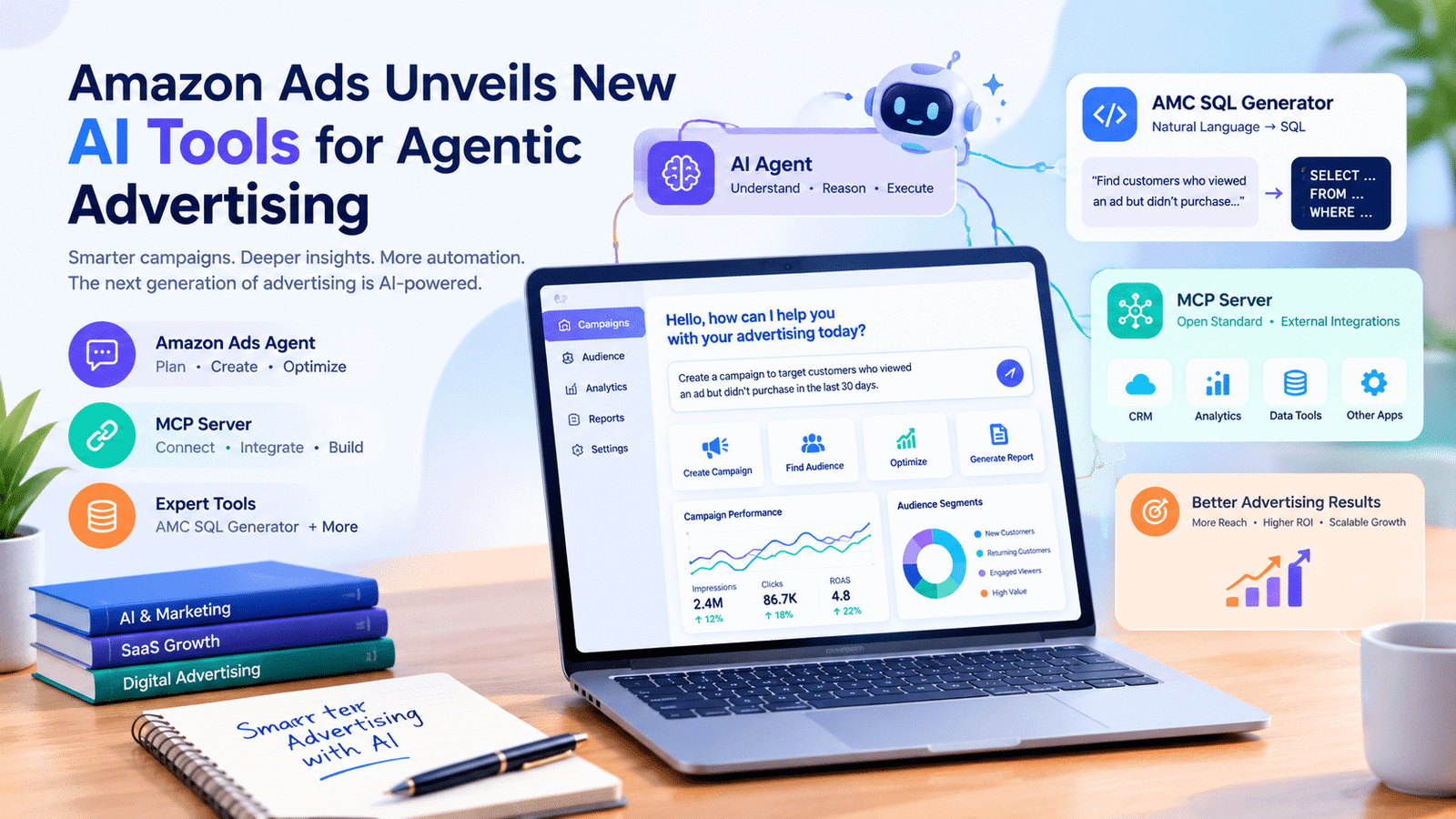
If you have ever spent an afternoon jumping between campaign settings, performance reports, and a half-finished spreadsheet just to answer one simple question, you will understand why the new Amazon Ads AI tools are getting so much attention.
On September 29, 2026, Amazon announced a broader rollout of its AI advertising features. The idea behind them is easy to state. Instead of learning where every setting lives, you describe what you want in everyday language, and an AI agent handles much of the legwork. You stay in the driver’s seat, but you spend less time on the mechanics.
That sounds appealing, and it also raises fair questions. What do these tools actually do? Who can use them today? And what should marketers, agencies, and software founders be doing about them? This guide walks through each piece in plain language.
What are Amazon Ads AI tools, exactly?
“Amazon Ads AI tools” is not a single product. It is a growing family of AI-powered features built into Amazon Ads, and the most visible member is Ads Agent.
Ads Agent is a conversational assistant. You type or speak a request, and it helps with tasks across the advertising process, including:
- Planning media and setting up campaign structures
- Managing and optimizing campaigns, including at scale
- Finding relevant audiences
- Understanding performance and spotting what changed
- Writing queries for Amazon Marketing Cloud
If you have used a general chatbot, the format will feel familiar. The difference is that this assistant is connected to real advertising accounts and real campaign controls, so its answers can turn into actions rather than just suggestions.
Why “agentic” is more than a buzzword
You will see the phrase agentic advertising in most coverage of this announcement, so it helps to understand what it means.
Traditional ad automation runs on rules you define in advance. If cost per click rises above a certain level, lower the bid. If a budget is nearly spent, send an alert. These rules are useful, but they only do exactly what they were told to do.
An agent is built differently. You give it a goal, such as “find out why my conversion rate dropped last week and suggest a fix.” It then works out the steps, pulls data from the tools it can access, reasons about what it finds, and comes back with a proposal for you to look at. It can handle a chain of tasks instead of one narrow trigger.
That is a real change in how software behaves. It also explains why the human review step matters so much, which we will come back to.
The Amazon Ads MCP Server, in plain terms
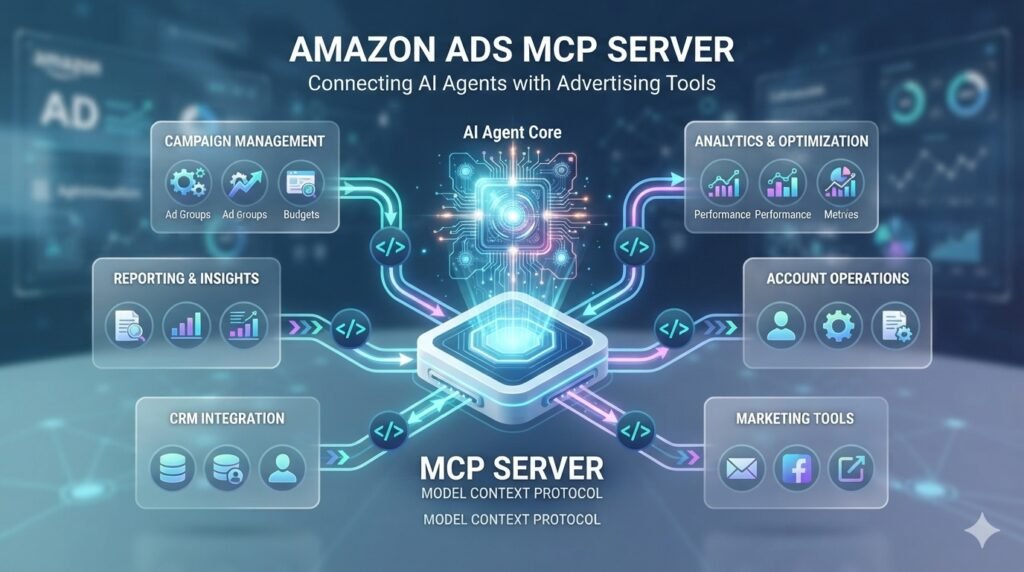
The second major piece is the Amazon Ads MCP Server, which Amazon introduced in February 2026.
MCP stands for Model Context Protocol, an open standard that gives AI systems a consistent way to connect to outside tools and data. If you have ever needed a different charger for every device you own, you already understand the problem MCP tries to solve. Without a standard, every AI assistant needs its own custom connection to every service. With one, a single well-built connection can serve many.
The Amazon Ads MCP Server plays that role for advertising. The basic flow looks like this:
AI agent → MCP Server → Amazon Ads features
A connected agent can use the server to help with campaign management, reporting, account operations, and similar workflows. Notably, this works beyond Amazon’s own console. An agency’s internal assistant or a software company’s product can plug in without a bespoke integration for each feature.
For developers, that means less plumbing and more time spent on the part users actually care about: the workflow.
Expert tools: the newest layer
The latest addition is a category Amazon calls expert tools.
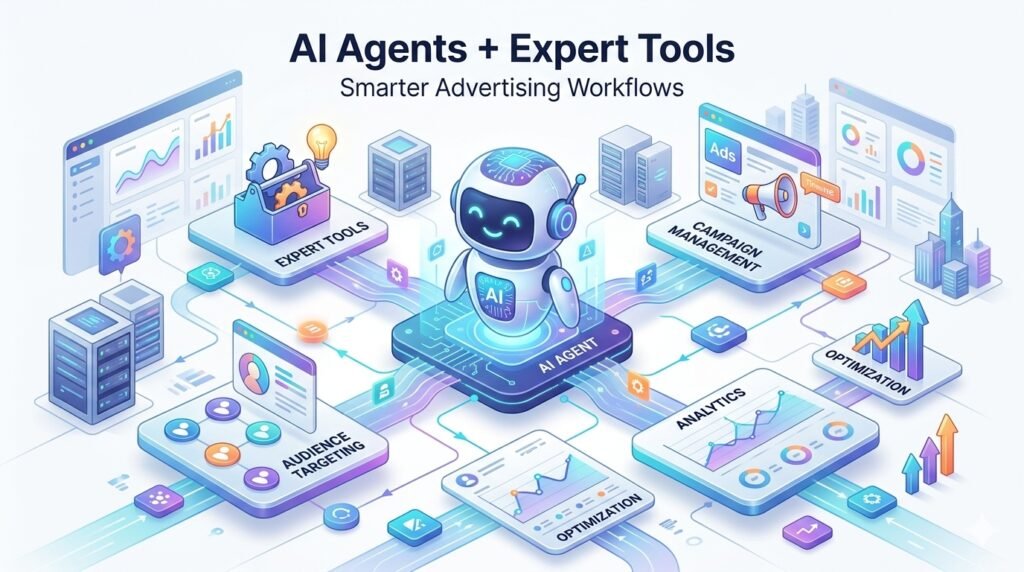
The distinction is simple. An ordinary tool performs a defined action, such as pulling a report. An expert tool adds specialist Amazon Ads knowledge, reasoning, and checks to a harder task, so the result is more likely to be correct and usable.
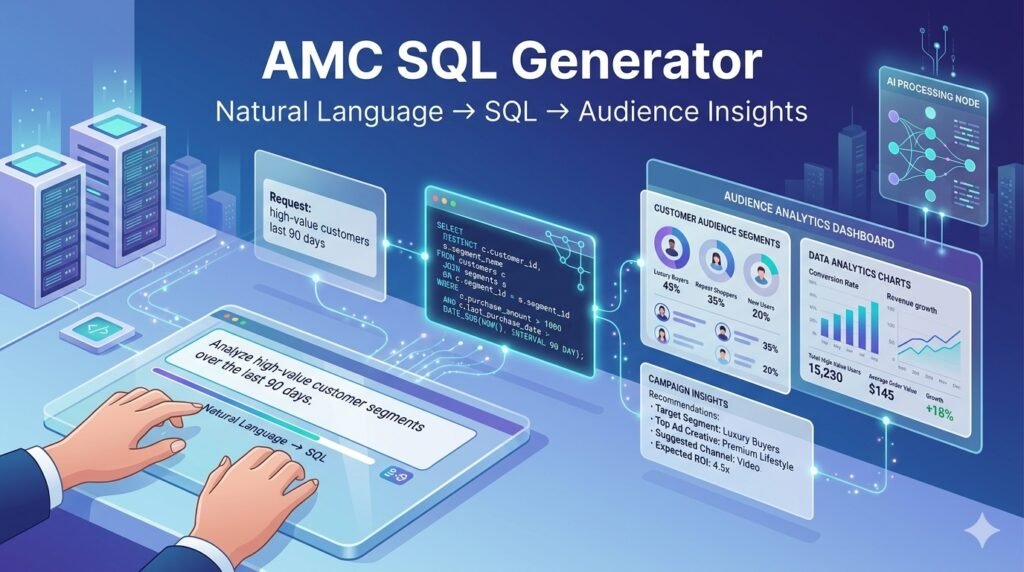
The first one announced is the AMC SQL Generator Expert Tool. It converts a plain-language request into a validated SQL query for Amazon Marketing Cloud. According to MediaPost’s reporting, it has entered a closed beta in the United States, with broader availability planned for early 2027.
Amazon Marketing Cloud is powerful, but it is also a place where many marketers get stuck, because useful audiences and analyses often require SQL. Plenty of experienced advertisers know precisely who they want to reach and simply cannot write the query to find them.
With this kind of tool, you could describe the need instead:
“Show shoppers who viewed our product in the last 30 days but didn’t buy.”
The tool then drafts the query for you to review. Because the word “validated” is part of the description, the goal is a query that has been checked before it reaches you, not one you have to debug yourself.
What a workflow might look like
It is easier to see the value in a concrete example, so imagine a small brand manager named Priya. She sells kitchen gadgets and suspects she is losing shoppers who look at her products but never buy.
The old way: Priya explains the idea to an analyst. The analyst locates the right data, writes the SQL, tests it, and sends it back with a question. Priya builds the audience, launches a campaign, and checks results a week later. Several days pass before anything runs.
The new way: Priya describes the audience to Ads Agent. The AMC SQL Generator drafts the query. She reviews it, approves it, and asks the agent to suggest a campaign structure for that audience. She reviews the proposed changes before they go live. The same steps happen, but many of the handoffs disappear.
Notice what did not change. Priya still decided which audience was worth chasing. She still judged whether the budget made sense. The tools removed friction, not responsibility.
Why marketers should care
The biggest benefit is not novelty. It is speed and independence.
When technical steps sit between an idea and its execution, good ideas get delayed or dropped. If an AI agent can shorten that gap, small teams can test more ideas, and busy teams can spend their limited hours on thinking instead of setup.
Amazon also emphasizes that advertisers keep control. Proposed changes can be reviewed before they are applied. That design choice is important, because it turns the agent into something closer to a capable assistant than an autopilot. Your role shifts toward strategy, creative direction, and business judgment, and away from repetitive configuration.
Some caution is still sensible. AI-generated recommendations can be wrong, and a plausible-sounding suggestion is not automatically a good one. Treat the agent’s output the way you would treat work from a fast new colleague: useful, worth reading carefully, and worth checking before you sign off.
What it means for SaaS founders and developers
If you build software, the more exciting story is how much easier advertising has become to build on.
Because AI agents can act as a bridge between people and complicated systems, a small team can create products that used to require a large engineering effort. With the MCP Server and expert tools available, a SaaS product could help customers:
- Explain campaign performance in normal sentences
- Suggest audience segments based on business goals
- Draft weekly or monthly reports automatically
- Flag optimization opportunities before budget is wasted
- Combine ad data with CRM, analytics, or email systems
The opportunity is in focus. Rather than launching yet another general-purpose chatbot, a startup can pick a narrow job, such as reporting for local retailers or audience planning for subscription brands, and orchestrate existing capabilities to do that job well. Niche tools tend to earn loyalty faster than broad ones.
There is a practical note here too. Access to some of these features depends on beta programs and eligibility, so it is worth confirming what you can actually use before committing product plans to it.
Paid ads are only half of growth
Even the smartest advertising workflow will not build your whole audience. Most AI and SaaS companies grow through a mix of paid campaigns, content, reviews, communities, and listings on the platforms where buyers already browse.
That is where directory presence can help. AI Listingo works with AI tools, SaaS products, and startups on manual directory submissions and visibility campaigns. If you are building discoverability alongside paid acquisition, its AI and SaaS directory submission services are a reasonable place to start, and the AI Listingo blog covers related marketing topics.
Directory listings are not a substitute for advertising. They work best as one piece of a wider plan that includes SEO, content, product launches, and paid campaigns. Ads bring traffic quickly, while organic visibility tends to build slowly and last longer, so the two complement each other.
Will AI replace advertising professionals?
It is the question everyone asks, and the honest answer is: unlikely, but the job will change.
AI is fast at handling data and repetitive steps. It does not automatically understand your brand voice, your profit margins, your seasonal cash flow, or whether a particular audience actually fits your customer. Decisions involving large budgets, sensitive customer data, or messy attribution questions still need a person who understands the business and will own the result.
The professionals who do best are likely to be those who learn to direct these tools well: asking clear questions, checking outputs critically, and applying judgment where the software cannot.
How to prepare right now
You do not need to wait for full availability to get ready. A few practical steps:
- Clean up your account structure. Clear naming and organized campaigns make it easier for any agent, or any human, to understand what is going on.
- Write down your goals. Agents work best when the objective is specific. “Grow sales” is vague. “Lower cost per purchase on my top three products” is something an agent can work with.
- Decide your review rules. Choose which changes you will always approve manually, such as budget increases, before you start delegating.
- Check eligibility. Look at Amazon’s official pages to see which features are open to your account and marketplace.
- Start small. Try the tools on a low-risk task first, like reporting, before handing over anything that spends money.
What to watch next
Even if you never advertise on Amazon, the pattern here is worth noticing: natural language, AI reasoning, connected tools, and human approval. The same recipe is likely to show up in CRMs, email platforms, analytics dashboards, customer support software, and SEO tools.
In other words, the way we use business software may slowly move from “learn every menu” to “explain what you want and check the result.” Amazon is one of the first large platforms to build for that future openly, which makes it a useful preview.
Final thoughts
The new Amazon Ads AI tools show where digital advertising is heading. Ads Agent gives marketers a conversational way to plan and manage campaigns. The MCP Server lets outside agents connect to Amazon Ads features. Expert tools like the AMC SQL Generator add specialist knowledge to complicated tasks. Each covers a different part of the workflow, and together they point toward advertising that is more about describing outcomes and reviewing proposals than clicking through dashboards.
The technology is still developing. Availability varies by product, market, and beta eligibility, and features will change as programs expand. Before you plan around any specific capability, confirm it in Amazon’s official documentation.
Frequently asked questions
What are Amazon Ads AI tools?
They are AI-powered features that help advertisers plan, launch, analyze, and optimize campaigns. Ads Agent is the main conversational experience.
What does the Amazon Ads MCP Server do?
It lets external AI agents connect to Amazon Ads features through the Model Context Protocol, so developers can build AI-driven advertising workflows without custom integrations.
What is the AMC SQL Generator?
It is an expert tool that turns plain-language audience or analysis requests into validated SQL queries for Amazon Marketing Cloud. It is currently in closed beta in the U.S.
Do I still need to review what the AI suggests?
Yes. Amazon says proposed changes can be reviewed before they are applied, and you should use that step, especially for anything involving budget.
Can I use these tools today?
Not necessarily. Access depends on your account, marketplace, and beta eligibility.
Disclaimer
This article is prepared for informational and educational purposes. Information regarding Amazon Ads and its AI-based features, Amazon Ads Agent, etc., is provided based on publicly available data and may be subject to change.
AI Listingo is an independent website and not connected with Amazon or Amazon Ads in any way unless otherwise indicated. All trade marks, brand names, product names, etc., are the property of their respective owners.
Availability, performance, and eligibility criteria for Amazon Ads AI features may differ depending on the account type, location, advertising program, and time period. Readers are advised to verify the most up-to-date information on official Amazon Ads websites before making decisions.
AI Listingo does not make any guarantees of the results you can achieve from the use of certain advertising strategies or tools described in this article.
Using information provided in this article implies that you are solely responsible for your choice of the appropriate advertising tool for your business.