
For a long time, search was simple for SaaS companies. Get a page onto Google, push it higher, bring in more visitors.
That still matters. But search is getting more conversational.
People now use AI-powered search to ask questions, compare software, and research solutions. Instead of typing a short keyword like “CRM software for startups,” someone might ask:
Which CRM tools are suitable for a small SaaS company with a five-person sales team?
That shift has sparked a lot of talk about GEO vs SEO.
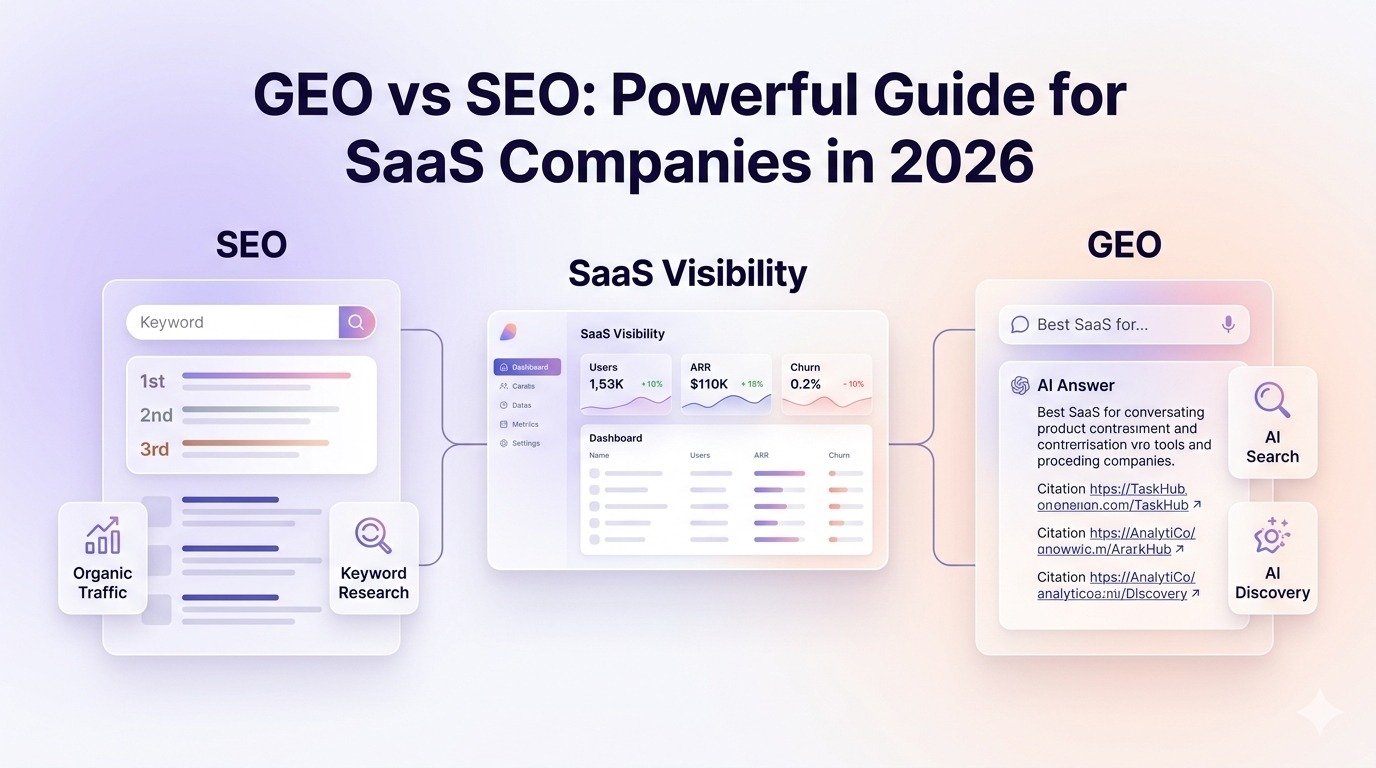
GEO usually stands for Generative Engine Optimization. It describes efforts to improve how visible your brand is in AI-generated search experiences. SEO, or Search Engine Optimization, is about visibility in traditional search results.
So are they two completely different strategies? For SaaS businesses, the honest answer is: not really.
What Is SEO?
SEO is the established practice of making a website easy for search engines to crawl, understand, and rank for relevant searches.
A SaaS SEO strategy usually includes:
- Keyword research
- Search intent analysis
- Technical SEO
- Helpful content
- Internal linking
- Site architecture
- Page optimization
- Digital PR and relevant links
- Structured data
- A better user experience
Say you run a project management tool. You might write a detailed guide on “project management software for startups,” optimize it around that topic, explain the category properly, link to related resources, and make sure search engines can reach and understand the page.
SEO is still very much relevant in 2026. Google's own guidance says SEO best practices continue to apply to its generative AI search features, because those features are built on the same Search ranking and quality systems.
What Is GEO?
GEO stands for Generative Engine Optimization. People use the term for strategies that aim to get a brand, product, or piece of content surfaced or referenced in AI-generated answers.
Notice how the question itself changes. A traditional search might look like this:
best accounting software for startups
An AI-style search sounds more like this:
What accounting software would you recommend for a small SaaS startup that wants simple invoicing and expense tracking?
The second question expects a full answer, not a list of links. An AI system has to work out what the person wants, find relevant products, and pull the information together from the sources it can see.
That's why a clear brand, useful content, trustworthy information, and a strong presence across the web matter more and more.
GEO vs SEO: What's the Difference?
The easiest way to understand GEO vs SEO is to ask what each one is trying to achieve.
| SEO | GEO |
|---|---|
| Focuses on search engine visibility | Focuses on visibility in generative AI experiences |
| Targets search queries and topics | Targets conversational and complex questions |
| Often measures rankings and organic traffic | Can involve mentions, citations, referrals, and AI visibility |
| A strong technical foundation is important | A strong technical foundation still matters |
| Content quality is important | Content quality and clarity are important |
| Links and authority can matter | Third-party mentions and credible sources can help provide context |
| Focuses heavily on search results | Focuses more on AI-generated answers and discovery |

That doesn't mean you need two separate marketing teams. In many cases, the same solid SEO foundation helps you show up in newer AI search experiences too.
Why SaaS Companies Are Paying Attention to GEO
Software is a natural fit for conversational search. Buyers usually have detailed questions before they commit. They want to know:
- Which tool suits their team?
- Which product supports a specific integration?
- Which platform works for their industry?
- Which software fits their budget?
- How does one product compare with another?
- What alternatives are out there?
Those aren't always simple keyword searches. AI search gives people a more conversational way to work through them.
So think beyond ranking for individual keywords. Make sure your product is described clearly across the web, too.
SEO Still Provides the Foundation
One of the biggest mistakes in the GEO vs SEO debate is treating GEO as a replacement for SEO.
Google's guidance says SEO fundamentals still matter for generative AI features in Search. It points to technical accessibility, unique and useful content, and people-first information, and it steers people away from chasing so-called “GEO hacks.”
That's worth taking seriously. Before you worry about AI visibility, check that your website actually works. Your pages should be:
- Crawlable
- Indexable
- Fast enough for users
- Mobile-friendly
- Clearly structured
- Easy to navigate
- Written for real users
- Supported by useful internal links
If the foundation is weak, an AI-focused strategy won't magically fix it.

How SaaS Companies Can Prepare for GEO
Nobody has a guaranteed formula for getting a SaaS product mentioned by an AI system. What you can do is improve the quality and spread of the information available about your product.
1. Explain Your Product Clearly
Your homepage should answer the basics quickly:
- What does your software do?
- Who is it for?
- What problem does it solve?
- What are the main features?
- What makes it different?
Skip vague marketing language when something specific would help. For example:
AI-powered next-generation workflow innovation.
doesn't tell a potential customer much. Compare it with:
AI workflow software that helps small marketing teams automate repetitive campaign tasks.
The second version is far easier to understand.

2. Build Useful, Topic-Focused Content
Write about the questions your customers actually ask. A CRM company, for instance, could publish:
- CRM for startups
- CRM vs spreadsheets
- How to manage SaaS leads
- Best CRM integrations for small teams
- How to choose CRM software
- A CRM implementation checklist
The goal isn't hundreds of pages. It's to be genuinely helpful around the problems your customers are trying to solve.
Google's guidance on helpful, people-first content puts the emphasis on effort, originality, usefulness, and accuracy, not on producing large volumes of automatically generated pages.
3. Strengthen Your SaaS Directory Presence
Directories are one more part of the wider SaaS discovery ecosystem. The right platforms help potential customers find your software outside your own website.
Depending on your product, you might consider:
- SaaS directories
- AI tool directories
- Software review websites
- Startup directories
- Product discovery platforms
- Industry-specific directories
Not every directory is worth your time. Relevance matters. A small number of accurate, relevant profiles can mean far more than submitting your product to hundreds of unrelated websites.
If you'd like help building this kind of presence, AI Listingo offers manual AI and SaaS directory submission services.

4. Keep Product Information Consistent
Suppose your website calls your product an AI video editor. One directory calls it a social media management platform. Another profile says it's mainly a graphic design tool. That leaves a muddled picture of what your company actually does.
Keep these details consistent across your online profiles:
- Product name
- Company name
- Product category
- Key features
- Target audience
- Main use cases
- Website address
- Product description
Descriptions don't need to be identical everywhere, but the underlying facts should stay accurate.
5. Earn Genuine Reviews and Mentions
Third-party sources add context about your company that your own website can't. Encourage real customers to leave honest reviews on the platforms that matter in your space.
Then look for legitimate ways to earn mentions through:
- Industry publications
- SaaS blogs
- Interviews
- Podcasts
- Case studies
- Product comparisons
- Startup communities
- Expert contributions
The focus should be on genuine visibility. Fake reviews or artificial mentions might look like a shortcut, but they aren't a sustainable strategy.
6. Use Structured Data Correctly
Structured data helps search engines understand what's on a page. Google supports it for several content types, including Organization, Product, Software App, and Article. Its introduction to structured data is a good place to start.
For a SaaS website, it can help communicate information about your company, product, or content. Just make sure it accurately matches what's visible on the page. It isn't a shortcut for ranking.
7. Monitor Search Performance
Keep using tools like Google Search Console to see how your site performs in search.
Google has also been expanding its reporting. Its existing reports include performance from generative AI features, and on September 24, 2026 it announced new Search Console reporting for multimodal searches, meaning searches that start with an image. It gives publishers a few more ways to see how people find their content.
GEO vs SEO: What Should SaaS Companies Focus On?
Instead of asking, “Should we do GEO or SEO?” try this:
How can we build a search strategy that works across traditional and AI-powered discovery?
For most SaaS companies, that means building a strong SEO foundation first and then widening your visibility from there. A practical order might look like this:
- Fix technical SEO issues.
- Create useful, original content.
- Build pages around important customer use cases.
- Improve internal linking and site structure.
- Create accurate SaaS and product profiles.
- Earn genuine reviews and third-party mentions.
- Monitor organic and referral traffic.
- Test relevant AI search queries and see how your brand appears.
That's far more sustainable than chasing every new “AI SEO trick.”

What About AI-Generated Content?
AI can be a real help when you're creating content. It's good for:
- Brainstorming
- Organizing research
- Outlining
- Editing
- Summarizing
- Content planning
But review and improve everything before it goes live. Google's guidance on generative AI content is clear that using it to mass-produce pages without adding value can run into its spam policies. A generic article that repeats what's already online won't offer much.
Add something original, like:
- Your team's experience
- Customer examples
- Product testing
- Original research or data
- Screenshots
- Expert commentary
- Practical recommendations
Aim to create content that deserves to be read.
Common GEO Mistakes to Avoid
- Chasing “GEO hacks.” There are plenty of claims online about secret formulas for getting mentioned by AI. Be careful. Google's current guidance warns against focusing on supposed AEO/GEO hacks instead of established SEO practices.
- Creating content only for AI. Write for people first. If a human reader finds the article useful, you're heading in the right direction.
- Publishing piles of low-quality pages. More pages don't automatically mean more visibility. Quality, usefulness, originality, and accuracy matter.
- Ignoring traditional SEO. AI search doesn't make technical SEO irrelevant. Your site still has to be accessible and understandable to search systems.
- Expecting guaranteed AI mentions. No ethical SEO or GEO service can guarantee that a particular AI platform will mention your product. Responses vary by query, system, available sources, location, freshness, and more.
The Future of SaaS Search Is Not Simply GEO vs SEO
The debate around GEO vs SEO makes it sound like you have to pick a side. In reality, the two overlap a lot. SEO gives you the technical and content foundation. GEO is a newer way of thinking about visibility in generative search.
For SaaS companies, the bigger opportunity is a strong online presence that works across the whole discovery journey.
Picture a potential customer. They might first find your brand on Google. Then they read a review on a software platform. Later they spot your product in a SaaS directory. They read a comparison article. Finally, they ask an AI assistant about you.
Every one of those touchpoints shapes how your brand is discovered and understood.
How AI Listingo Can Support SaaS Visibility
Building a broader online presence takes time, and founders and SaaS teams already have product development, support, sales, and marketing to juggle.
AI Listingo helps AI and SaaS businesses with manual directory submissions to relevant AI, SaaS, startup, and business directories.
Directory submissions aren't a guarantee of rankings or AI mentions. But keeping accurate profiles across relevant platforms can create extra discovery points for your product.
You can learn more about AI Listingo's AI and SaaS directory submission services, or browse the AI Listingo blog for more articles on AI, SaaS, SEO, directories, and online visibility.
Final Thoughts
The GEO vs SEO conversation isn't going away as search gets more conversational and AI-powered. But SaaS companies don't need to throw out everything they know about SEO.
A better approach is to strengthen the fundamentals. Build a technically sound website. Create genuinely useful content. Explain your product clearly. Earn relevant third-party visibility. Keep your directory profiles accurate. Collect genuine customer reviews. And keep measuring how people find you.
How AI systems pick and present information will keep changing. Rather than hunting for a shortcut, focus on something more durable: a useful product with a clear, credible, and easy-to-find online presence.
That's where SEO and GEO work best together.