You’ve shipped the product. The landing page is live, the demo works, and a handful of early users have signed up. Now comes the part nobody warns you about: getting found, and getting believed.
Think about how you research a company you’ve never heard of. You don’t stop at the homepage. You check who runs it, whether anyone has invested, how long it has existed, and what other people say about it. Your future customers, partners, journalists, and investors do exactly the same thing. That’s why Crunchbase for SaaS and AI startups deserves a place on your launch checklist.
This guide covers what the platform does, how founders use it, how to set up a profile that holds up to scrutiny, and where its limits are.
What Is Crunchbase, Really?
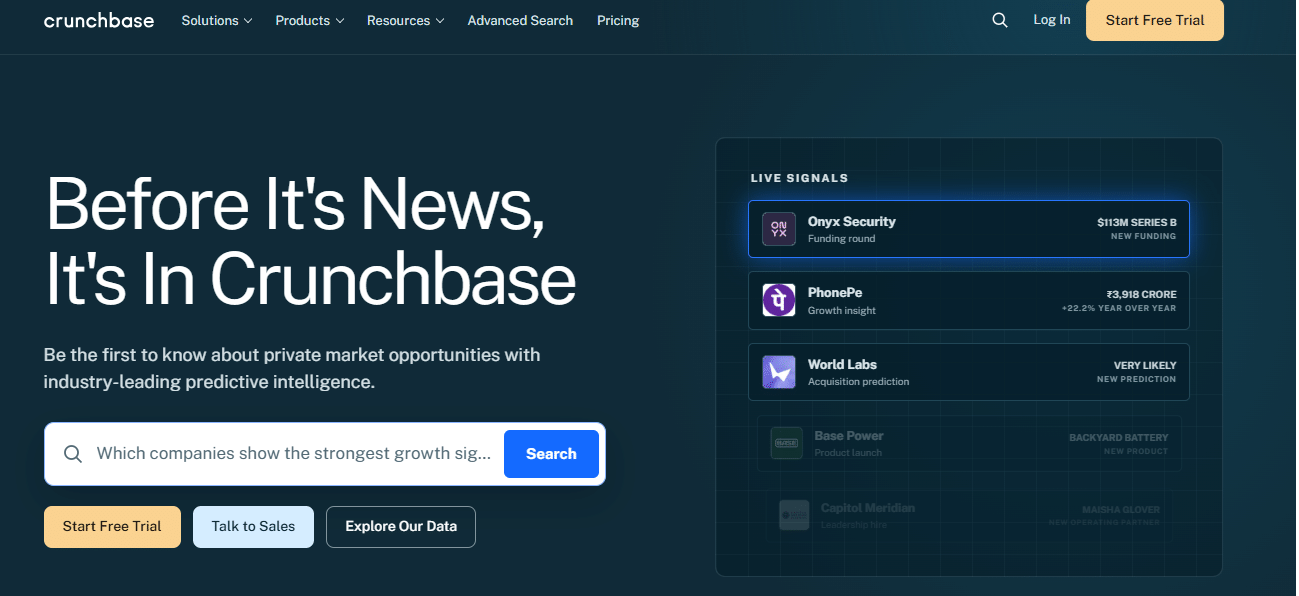
Crunchbase began as a simple startup database and has grown into a broader private-company intelligence platform. It collects information on companies, founders, investors, funding rounds, acquisitions, and industry trends. You can see the current product lineup on the Crunchbase about page.
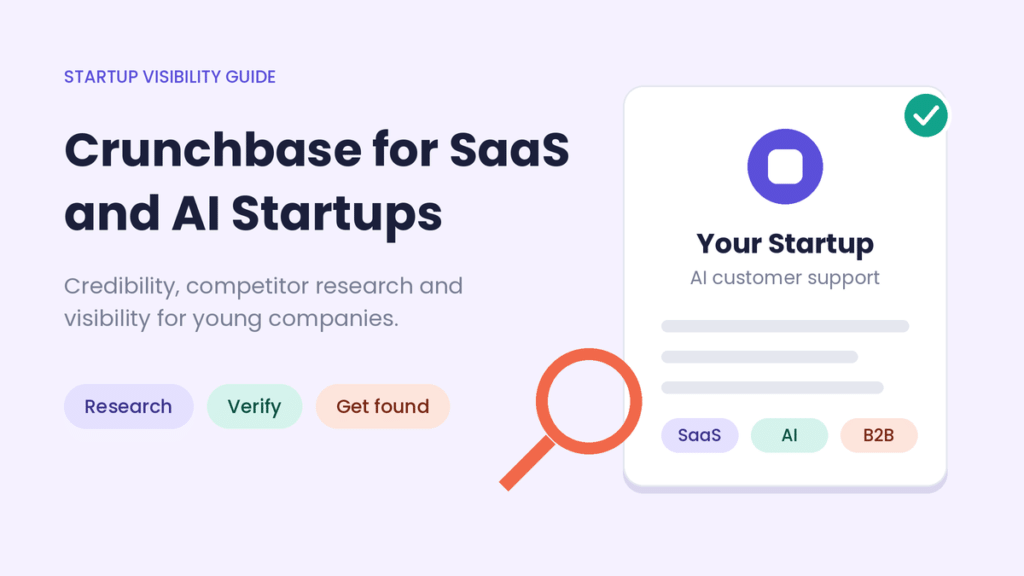
A typical company profile shows a short description, website, headquarters, founding date, leadership team, funding history, investors, and related companies. More recent features layer on predictions and growth signals built with machine learning.
The easiest way to understand it is as a reference book with two readers. One reader is you, looking up everyone else. The other is everyone else, looking up you. Most founders only think about the first role, but the second is where the credibility comes from.
Why Crunchbase for SaaS and AI Startups Matters Right Now
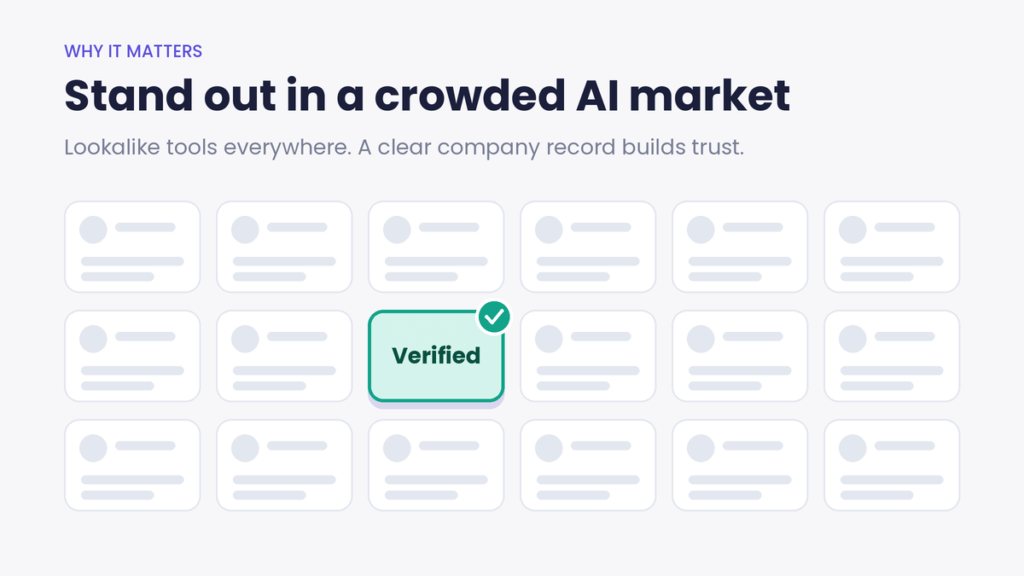
SaaS has always been competitive. AI has made it even more crowded. A new “AI-powered” tool appears almost daily, and many of them describe themselves in nearly identical language. Buyers are skeptical, and understandably so.
In that environment, a product page alone is weak evidence. Anyone can write a confident homepage in an afternoon. What’s harder to fake is a consistent paper trail: a company record with named founders, a real location, a sensible description, and a history that matches what you say on your own site.
That paper trail is what Crunchbase can give you. It won’t make your product better, and it won’t send a flood of visitors. What it does is shorten the distance between “I’ve never heard of this company” and “okay, this looks legitimate.”
For AI startups the effect is even stronger. Buyers are more cautious about data handling, reliability, and who is behind a model. Seeing a transparent company record helps answer the quiet question of whether a team will still be around next year.
How Founders Actually Use It
Here are the situations where the platform earns its keep.
Being easy to verify
When an investor, reporter, or enterprise buyer hears your name, there’s a good chance they’ll type it into a few places in the first ten minutes. If a complete profile appears, they can confirm the basics immediately. If nothing appears, or the entry is half-finished and years out of date, it adds a small but real bit of friction.
Studying your competitors
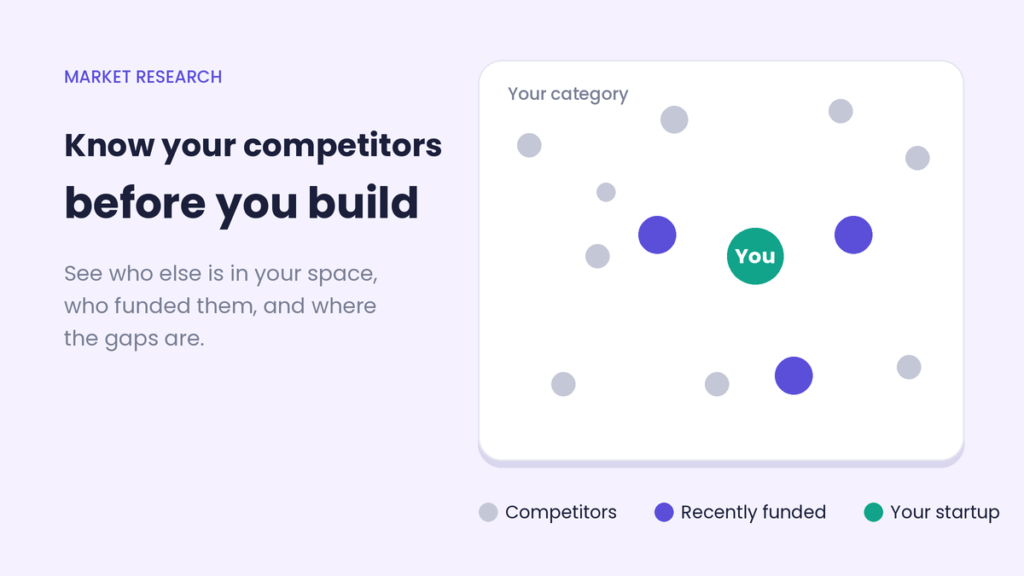
Search your category and you’ll quickly see who else is building in it. You can compare locations, team size, funding stages, and investors. The “similar companies” suggestions often surface startups you hadn’t come across, including newer ones that haven’t gained much press yet.
This doesn’t replace talking to customers or testing rival products yourself. It simply gives you a map before you start walking.
Learning how money moves in your niche
Even if you have no plans to raise capital this year, reading through funding rounds in your space teaches you plenty. Which investors keep backing tools like yours? How big are typical seed rounds? Which companies were acquired, and by whom? That context makes any future fundraising conversation less of a guessing game.
Sizing up a market before you commit
Suppose you’re considering an AI tool for sales teams. Before you spend six months building, you could filter companies by industry, region, and stage to see how saturated the area already is. A crowded field isn’t necessarily bad news, but you should know about it early.
Finding partners and prospects
Because profiles include industries, locations, and company size, the platform doubles as a lead-research tool. Founders selling B2B sometimes use it to build lists of target accounts, and others use it to find integration partners in adjacent categories.
Setting Up Your Profile the Right Way
A rushed profile can do more harm than good. Take thirty minutes and do it properly.
Search first. Many companies already have an entry created by someone else, sometimes with outdated details. Creating a second profile causes confusion. Crunchbase’s support center explains how to claim and edit an existing page, and it’s worth reading before you touch anything.
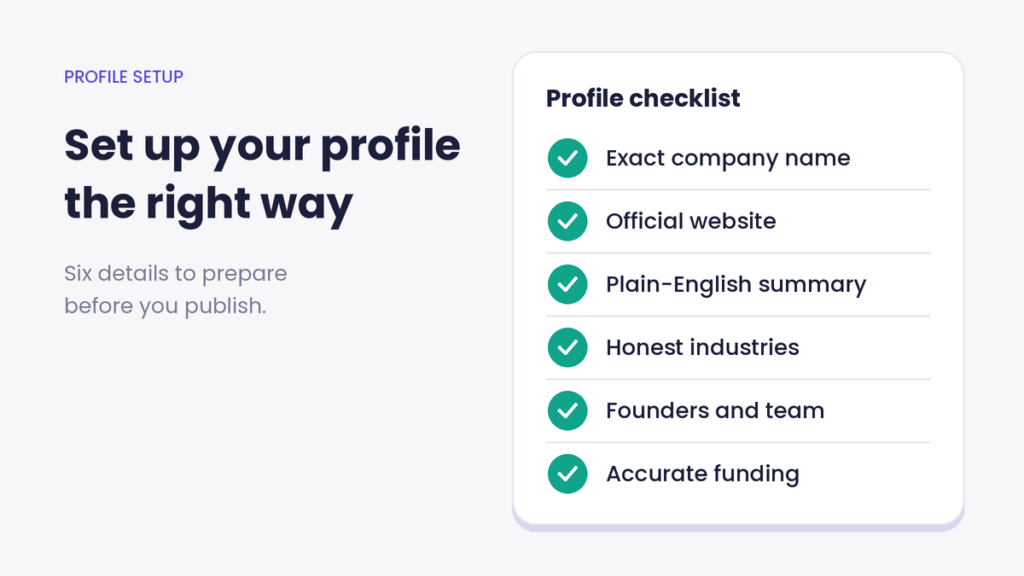
Gather your facts. Have these ready so you aren’t improvising:
- Your official company name, spelled exactly as on your website
- The primary website URL
- A one- or two-sentence summary of what the product does and who it serves
- A longer description covering the problem you solve and what makes you different
- Founding date and headquarters location
- Founder names and key team members
- Funding details, if you’ve raised any
- Links to your genuine company social accounts
Write like a person. The most common mistake is stuffing a description with buzzwords such as “revolutionary,” “next-generation,” and “AI-driven synergy.” Nobody trusts those phrases anymore. Compare these two descriptions:
Weak: “A cutting-edge AI platform transforming the future of customer engagement.”
Better: “An AI assistant that answers routine support tickets for online stores, so small teams can handle more customers without hiring.”
The second tells you what it is, who it’s for, and why it exists. That’s all a profile needs to do.
Choose categories honestly. Pick the industries that really describe your business, not the ones that happen to be trending. Misleading categories attract the wrong audience and erode trust when people look closer.
Keep everything consistent. Your name, description, and facts should match your website, your LinkedIn page, and every other listing. Inconsistency is one of the fastest ways to look careless.
Keep Your Expectations Realistic
A lot of content online oversells profile-building. Let’s be straightforward about the limits.
A Crunchbase profile is not a guaranteed backlink, a promise of higher rankings, or a dependable traffic channel. Search visibility depends on content quality, technical health, authority, user behavior, and competition. Google’s own SEO starter guide is a sobering reminder of how much of that is work on your own site.
Likewise, creating a profile does not mean investors will find you and write checks. Early-stage companies in particular should treat the page as a record and a research tool, not a fundraising shortcut.
What it can reasonably do is add another consistent, credible mention of your business to the web. Over time, small signals like that contribute to a company being easy to find and easy to trust. That’s a modest benefit, and an honest one.
Crunchbase Versus Directories: Different Jobs
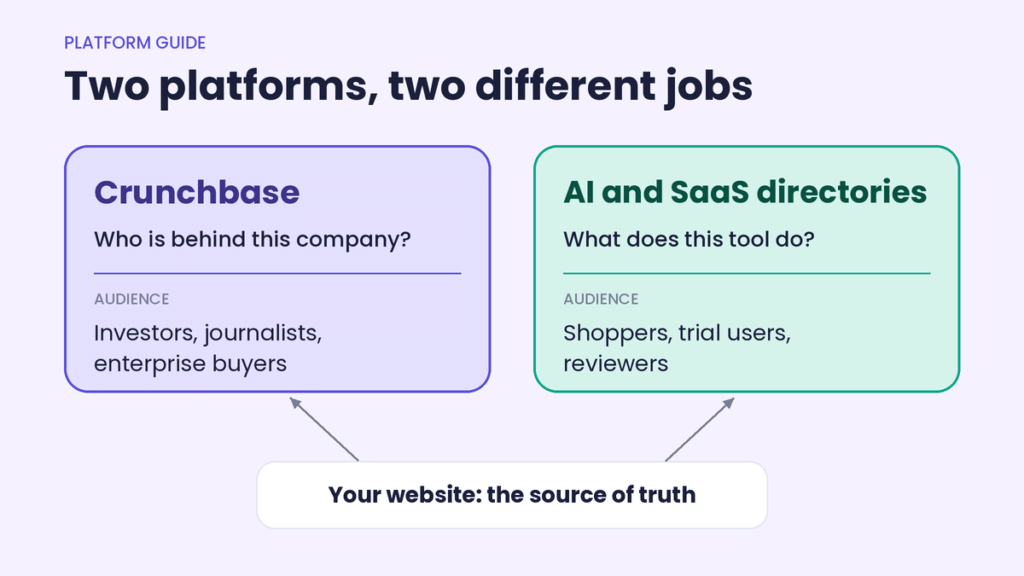
Founders sometimes ask whether they need Crunchbase if they’re already listing their product in AI and SaaS directories. The answer is yes, because the two answer different questions.
Crunchbase answers: Who is this company, and who is behind it?
Product directories answer: What does this tool do, and is it right for me?
A buyer looking for an AI writing assistant probably won’t search a funding database. They’ll browse a directory, a review site like G2, or a launch platform like Product Hunt. An investor or journalist, on the other hand, will lean on company databases. Covering both groups means being present in both places.
If product discovery is the gap in your plan, this roundup of the top 100 AI directories to submit your AI tool is a good place to start choosing where to list. For more on how listings fit into a wider growth plan, the AI Listingo blog is worth a browse.
A Quick Example
Imagine you’ve launched an AI platform that helps ecommerce stores answer support emails automatically.
Your website explains the features and pricing. But a store owner who finds you through a directory wants to know whether you’re a real, stable company. They look you up, and a clear profile shows your founders, your location, your industry, and your founding year. That small moment of confirmation can be the difference between a signup and a closed tab.
Meanwhile, a journalist writing about AI in retail finds you while scanning the category. The same profile gives them enough context to reach out. And you, while editing that page, notice three competitors you’d never heard of and spot that one of them recently raised a seed round. All of that came from the same short setup session.
Don’t Try to Do It All Alone
Here’s the practical issue: visibility work is repetitive and slow. Every directory has its own forms, category lists, character limits, and review rules. Submitting carelessly can get a listing rejected, and tracking dozens of accounts is a chore that pulls founders away from building.
This is the problem AI Listingo focuses on. It handles submissions manually rather than using scripts or bulk-posting software, which matters because many directories actively filter out automated entries. You can look through its services or read about its AI and SaaS directory submission service to see whether it fits your needs.
One honest caveat applies to any service in this space: approval can never be guaranteed. Each directory sets its own standards and makes its own editorial calls. Some approve quickly, some take weeks, and some decline listings outright. Anyone promising otherwise should make you cautious.
A Simple Visibility Plan You Can Follow
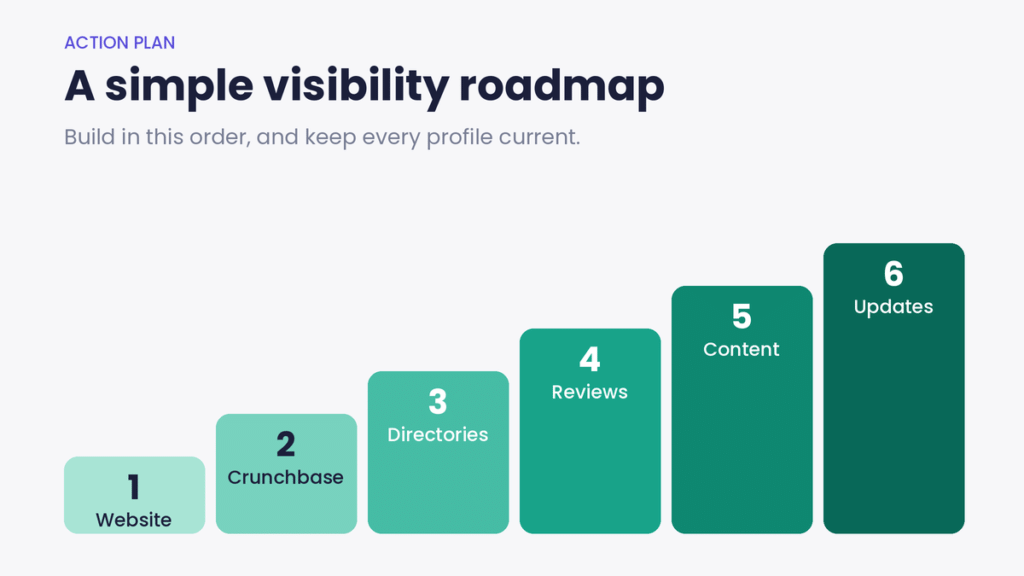
If you’re starting from scratch, this order works well:
- Fix your website first. It should state clearly what you do, who it’s for, and how to get started.
- Claim or create your Crunchbase profile. Search first, then fill in every relevant field accurately.
- List your product in the right directories. Choose a handful that your buyers genuinely use rather than chasing volume.
- Collect real reviews. Ask happy customers to share their experience on one or two review platforms.
- Publish useful content. Tutorials, comparisons, and honest case studies build authority over time.
- Review everything quarterly. Update team changes, new funding, pricing, and descriptions so no profile goes stale.
The temptation is to be everywhere at once. Resist it. A few accurate, well-maintained profiles beat dozens of abandoned ones every time.
Mistakes to Avoid
A few errors come up again and again:
- Creating duplicates. Always search before you add anything.
- Exaggerating. Inflated claims about funding, customers, or team size can damage trust quickly once someone checks.
- Letting data go stale. An outdated profile is worse than a short one, because it suggests the company has stopped moving.
- Ignoring the rules. Platforms update their guidelines, so read the current terms before editing.
- Expecting overnight results. Visibility is a slow build, and small signals compound over months, not days.
Final Thoughts
Used well, Crunchbase for SaaS and AI startups does two jobs at once: it helps you understand your market, and it helps your market understand you. It isn’t a growth hack, and it won’t replace a strong product, solid content, or real customer relationships. But as a trust signal and a research tool, it’s cheap, quick to set up, and easy to maintain.
Start with accuracy. Add the right directories next. Keep everything current as you grow. Done consistently, that approach builds the kind of steady, credible presence that makes a young company look like it’s here to stay.
Frequently Asked Questions
Is Crunchbase worth using for an early-stage startup?
Yes, mainly for credibility and market research. You don’t need to have raised money to have a useful profile.
Does a Crunchbase profile improve SEO?
Not directly or reliably. Treat it as one supporting mention of your brand, not a ranking tactic.
Who can create a company profile?
Registered and authenticated users can add or edit companies under Crunchbase’s current rules. Check its support pages, since the process can change.
Can I use it for competitor research?
Yes. You can look at rival companies’ funding, investors, locations, and related businesses to understand your competitive landscape.
Is Crunchbase only for companies that have raised funding?
No. It lists companies at every stage, from brand-new startups to established businesses.
Should Crunchbase be my only online listing?
No. Combine it with your own website, relevant AI and SaaS directories, review platforms, and consistent content.
Does AI Listingo guarantee that directories will approve my listing?
No. It submits manually and carefully, but every directory makes its own final decision.